
What I eventually figured out — through a lot of trial, error, and honest conversations with hairstylists who specialize in mature hair — is that gray hair frizz almost always comes down to a handful of very specific, very fixable habits. The good news is that none of these fixes require expensive products or a complete lifestyle overhaul. Most of them cost nothing at all. Once you stop making these mistakes and start replacing them with intentional habits, everything changes. Here’s what they are — and exactly what to do instead.
Why Gray Hair Gets Frizzy in the First Place
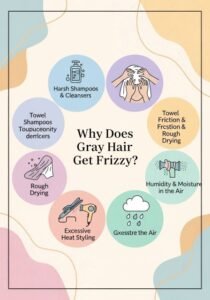
When hair loses its pigment, the melanin that used to fill the hair shaft disappears. That melanin wasn’t just responsible for color — it also helped retain moisture and kept the outer layer of each strand, called the cuticle, lying flat and smooth.
Without it, gray hair becomes more porous. It absorbs moisture quickly but loses it just as fast. The cuticle lifts more easily, which is exactly what creates that rough, wiry, frizzy texture.
To make matters more complex, gray hair also tends to be coarser in texture for many people. The hair shaft itself often becomes stiffer and less flexible over time, which can make it harder to style and more resistant to lying flat. Combine increased porosity, reduced natural oil production, and a coarser texture, and you have a recipe for persistent frizz that refuses to respond to the same products and routines that used to work perfectly well. Gray hair needs a different kind of care — and when it doesn’t get it, frizz becomes the daily norm.
1. Still Using a Shampoo With Sulfates
Sulfates are the cleansing agents in most standard shampoos — the ones that create that satisfying lather. They’re effective at removing oil, but they’re also harsh. On gray hair that’s already prone to dryness, they strip away whatever natural moisture your strands are trying to hold onto. This leaves the cuticle rough and open, which is a direct invitation for frizz to settle in.
For many people, the switch away from sulfate shampoos feels counterintuitive at first. The lather is less dramatic, and it can take a week or two for the scalp to recalibrate. But within just a few washes, most people notice their gray hair feeling noticeably softer, more manageable, and less prone to that straw-like dryness that shows up right after washing.
Look for shampoos labeled sulfate-free or gentle cleansing. Common sulfates to avoid on the ingredient label include sodium lauryl sulfate (SLS) and sodium laureth sulfate (SLES). You don’t need to spend a lot — many affordable drugstore options now offer sulfate-free formulas. If your hair tends to be fine or gets weighed down easily, look for a formula specifically designed for fine or color-treated hair. For thicker or very dry gray hair, a moisturizing or hydrating sulfate-free formula will serve you better. Co-washing — washing with conditioner only — is another option worth exploring if your hair is particularly dry, though it works better for some hair types than others.
2. Skipping Conditioner or Using Too Little
Some people skip conditioner because they worry about weighing their hair down or making it look flat. For gray hair, that’s one of the worst things you can do. Conditioner temporarily seals the cuticle, smoothing down those lifted edges that cause frizz and helping the hair hold onto moisture long after you’ve stepped out of the shower. Without it, freshly washed gray hair is basically primed for maximum frizz.
The common mistake isn’t just skipping conditioner entirely — it’s also using too little, applying it to the roots where it’s not needed, or rinsing it out too quickly. All of these reduce the benefit significantly.
Use a generous amount of conditioner — probably more than you think you need — and focus it on the mid-lengths and ends rather than the scalp. Leave it on for at least two to three minutes before rinsing. A weekly deep conditioning mask makes an even bigger difference. Look for masks containing shea butter, ceramides, or panthenol, which are particularly good at smoothing the cuticle and restoring softness. If your gray hair is quite coarse or dry, consider replacing your regular conditioner with a deep conditioner two to three times a week rather than just once.
3. Rubbing Your Hair Dry With a Regular Towel
A standard terry cloth towel is surprisingly rough on wet hair. When you rub with it vigorously, you’re physically lifting the cuticle in every direction, creating friction, and encouraging tangles — and wet hair is at its most fragile state. For gray hair with an already-elevated cuticle, this kind of physical roughness can undo every benefit of a careful wash and conditioning routine before you’ve even started styling.
This is one of those changes that sounds almost too small to matter, but the difference is surprisingly immediate and consistent.
Switch to a microfiber towel designed for hair, or simply use a clean cotton T-shirt. Both materials are far gentler on the cuticle because of how the fibers are structured. Instead of rubbing, gently squeeze or scrunch sections of hair to press the water out. Work from the ends upward. Your hair will be smoother from the start of the drying process, and everything you apply afterward will work better because it’s going onto a more cooperative surface.
4. Skipping Leave-In Products

Because gray hair is naturally more porous, it loses moisture to the air throughout the day. Hair that looks smooth in the morning can be puffed up and frizzy by afternoon just from humidity or dry indoor air — even when nothing has changed about your styling routine. The hair is simply releasing moisture and contracting, or absorbing ambient moisture unevenly, both of which cause the cuticle to lift and frizz to appear.
Rinse-out products alone — even excellent conditioners — can only do so much. Once they’re rinsed away, the protection goes with them. Leave-in products fill that gap by creating a lasting barrier on the hair shaft.
Apply a leave-in conditioner or a few drops of a lightweight hair oil to damp hair immediately after towel drying, before any other styling steps. For very fine gray hair, a leave-in spray will feel lighter than a cream or oil. For coarser or thicker gray hair, a leave-in cream or a few drops of argan, jojoba, or camellia oil may work better. On particularly humid days, a light anti-humidity serum applied over your usual leave-in product adds an extra layer of protection. Always apply while hair is still damp — not soaking wet — for the most even distribution.
5. Using Heat Without Proper Protection
Heat styling isn’t off-limits for gray hair, but it requires more care than it used to. Gray hair is already more porous and more fragile at the structural level. Without a protective barrier, high heat pulls moisture out of an already dry strand in seconds, and over time causes tiny structural breaks along the cuticle that make frizz progressively worse. Each time you apply heat without protection, you’re making the underlying problem harder to solve.
Many people also continue using the same temperature settings they used when their hair was younger and more resilient, not realizing that gray hair simply doesn’t need — or benefit from — those higher temperatures.
Use a heat protectant every single time before any heat tool touches your hair. Apply it to damp or dry hair depending on the product instructions, and cover all sections — particularly the ends. Lower your temperature setting to around 300–350°F. Try letting your hair air-dry to about 70 percent before finishing with a blow dryer. When blow-drying, use a diffuser attachment if your hair has any wave or curl to it, or use a round brush to smooth sections rather than repeatedly passing the dryer over the same spot.
6. Washing Your Hair Too Often
Gray hair doesn’t produce as much natural oil as younger hair does. The sebaceous glands that produce scalp oil become less active over time. That oil — called sebum — is actually one of the hair’s natural defenses against dryness and frizz. It travels down the hair shaft slowly, coating the cuticle and keeping it sealed and smooth. When you wash it away every day out of habit, you never give the hair a chance to benefit from even its limited natural moisture supply.
Daily washing also means daily exposure to cleansing agents, which adds up over time. The scalp can also overcorrect when stripped too frequently, sometimes producing more oil to compensate — leading to a frustrating cycle of washing more, which makes the hair even drier.
Experiment with stretching your washing schedule to two or three times per week. Most people find their scalp adjusts within a few weeks. Between washes, a light dry shampoo applied only to the roots handles any excess oil without disturbing the moisture in the rest of the strand. On non-wash days, a plain water rinse followed by a small amount of leave-in conditioner is a gentle way to refresh your hair without stripping it. For those transitioning away from daily washing, starting with every other day and gradually extending the gap makes the adjustment easier.
7. Ignoring Protein Balance
Hair is made of a protein called keratin, and it needs a careful balance of both moisture and protein to behave well. Many people addressing gray hair frizz focus exclusively on adding moisture — deep conditioners, oils, leave-in products — without ever thinking about protein. When you only use moisturizing products and never address protein, strands can become over-moisturized, which makes hair feel limp, gummy, and still frizzy in a different way that moisture alone will never fix.
The reverse is also true. When hair has too much protein and not enough moisture, it becomes dry, brittle, and prone to breakage. Finding and maintaining the right balance between the two is one of the less-discussed but genuinely important aspects of gray hair care.
Pay attention to how your hair feels as a guide. If your gray hair feels gummy or stretchy when wet and limp when dry, you likely need more protein. If it feels consistently dry, snaps easily, or feels rough even after conditioning, you need more moisture. Use a protein-containing deep treatment once or twice a month alongside your regular moisturizing routine. Look for products containing hydrolyzed keratin, hydrolyzed silk, hydrolyzed wheat protein, or rice protein. After a protein treatment, always follow up with a moisturizing conditioner to keep the balance in check. A simple test: stretch a wet strand — healthy hair stretches slightly and springs back. No stretch means it needs moisture; no spring-back means it needs protein.
Where to Start if Your Hair Feels Overwhelming Right Now
Don’t try to change everything at once. Overhauling your entire routine in a single week makes it nearly impossible to know which change is actually making a difference, and it can be frustrating if results don’t appear immediately. Instead, approach this strategically, one or two changes at a time.
Start with the shampoo and the towel — those two changes alone tend to produce the most noticeable early improvement, and neither requires buying anything expensive. Add a leave-in product next, incorporating it into your damp hair routine every wash day. Then work on heat protection and washing frequency. Give each change at least a full week before evaluating results, ideally two weeks. Gray hair frizz didn’t happen overnight, and it won’t disappear overnight either. But with consistent, targeted care, it absolutely does get better — and staying consistent is the part that matters most.
It also helps to keep a simple mental note of what your hair looks and feels like at each stage. Not everyone’s gray hair responds in exactly the same way or on the same timeline, and some of these fixes will make a bigger difference for you personally than others. The goal isn’t to follow a rigid system but to develop an intuitive understanding of what your hair actually needs — and to build habits that reliably give it those things.
Conclusion
Gray hair is beautiful, but it does ask for something different from you. Most gray hair frizz comes down to habits that made perfect sense for your old hair but simply don’t work anymore — sulfate shampoos that over-strip, skipping conditioner to avoid weight, rough towel drying, no leave-in protection, unprotected heat, washing too often, and neglecting the protein-moisture balance. None of these mistakes are hard to correct once you understand why they matter.
By switching to gentler cleansing, locking in more moisture at every step, handling wet hair more carefully, protecting against heat and humidity, giving your scalp’s natural oils time to do their job, and balancing protein with hydration, you give your gray hair exactly what it needs to look smooth, calm, and genuinely healthy. Small, steady adjustments — made consistently over a few weeks — are all it takes. And once your hair starts responding, and you start seeing that smoother, calmer texture you’ve been working toward, you’ll wonder why you didn’t make these changes sooner.

Hi, I’m Andrew Trust. For me, beauty has always been more than appearances—it’s about confidence, self-expression, and feeling your best every single day.
Over the years, I’ve explored, experimented, and discovered what truly works in hair and beauty. Not just trends or picture-perfect looks, but real techniques and tips that fit into everyday life and actually make a difference.
My goal is simple: to help you find the styles, routines, and little beauty tricks that bring out your best self—effortlessly and authentically. Beauty should feel enjoyable, empowering, and truly yours—and that’s exactly what I’m here to help you achieve.